The Lamp I Left in Better Hands: A Morning at the Repair Café
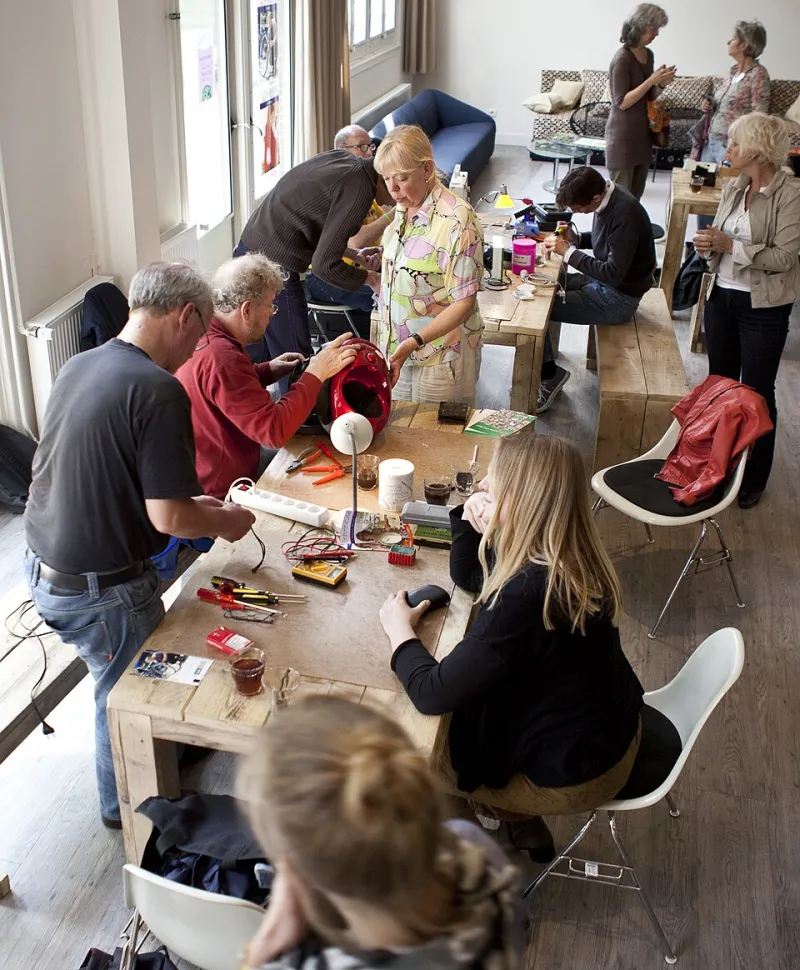
Photo: Ilvy Njiokiktjien, CC BY-SA 3.0, via Wikimedia Commons
On a damp Saturday in November, I joined a queue in a church hall with a broken table lamp under my arm. The lamp had a loose switch and a shade that listed slightly to the left. I had already tried the usual things: a new bulb, a wiggle of the cable, a firm talk with myself about being more practical. None of it worked. So I did something that felt oddly vulnerable. I took it to a repair café.
The lamp on the hall table
Repair cafés are not shops. They are gatherings. Since the first one opened in Amsterdam in 2009, the idea has spread into libraries, community centres, church halls and scout huts across the UK. You bring a broken thing — a toaster, a jumper, a bicycle brake, a lamp — and a volunteer sits down with you to see what can be done.
There is usually tea. There is often a queue. There is a donation tin rather than a price list, and nobody promises a miracle. What they offer is stranger and softer than a repair service: a table, a toolbox and another person’s attention.
I had expected to feel a bit foolish. I am a grown adult. I should be able to manage a lamp. But the volunteer did not make me feel foolish. She asked what I had already tried, listened to the answer, and then turned the lamp upside down with the calm of someone who has seen a thousand slightly broken things. ‘Let’s have a look,’ she said, as if that were the whole philosophy.
What actually happens at a repair café
At most repair cafés, you sit beside the volunteer rather than handing your item over a counter. That matters more than it sounds. You watch the screws come out. You learn what a worn flex looks like. You hear the small stories that gather around tools: the radio someone’s father kept in the shed, the sewing machine that has outlived three houses, the kettle that was a wedding present.
Not everything can be fixed. Some things are unsafe. Some parts are no longer made. Some volunteers will tell you kindly that the most sustainable option is to let it go. But even that is useful. It is a decision made with another person’s eyes on the problem, rather than in the closed loop of your own worry.
My lamp, as it turned out, needed a new switch and a little patience with the shade fitting. It took twenty minutes. I drank a cup of tea from a mug with a chip in the rim and listened to a man at the next table explain why his cassette player was worth saving. Nobody hurried him.
The quiet work of waiting
Waiting is part of the practice. You cannot scroll your way through a repair café in the same way you can through a bus stop. Your hands are busy holding a lamp, or a mug, or the edge of a table. The room is full of small sounds: a screwdriver turning, a sewing machine ticking, the low murmur of people comparing notes.
There is a particular relief in being somewhere you do not have to perform competence. You are not there to impress anyone. You are there because something is broken and you have decided to stop pretending otherwise. That is a surprisingly rare feeling in modern life, where so much of our worth seems to hang on being the person who has it all handled.
At 3 Spirit UK, we often write about gentle practices for modern stress. This one belongs in that family. It is not a cure for anything. It is simply a room where help is ordinary.
Why repair belongs in a wellbeing toolkit
Repair culture is usually framed as an environmental issue, and it is. Every fixed toaster is one less thing in landfill. But there is a body, mind and spirit case too. Sustainability can feel like another item on the to-do list, another way to be a good person and get it wrong. A repair café makes it social instead. It turns a duty into a conversation.
There is also the quieter lesson about interdependence. We are sold a story that competence is solitary: you should know how to do it yourself, or pay someone who does. Repair cafés interrupt that story. They suggest that some things are fixed by a pair of hands, some by a shared table, and some by admitting that you do not know what to do next.
That is not a small thing. For anyone carrying a lot at the moment — caring responsibilities, work pressure, the low hum of worry — the experience of sitting beside someone who says ‘let’s have a look’ can be its own kind of medicine. Not because the lamp matters so much. Because the asking does.
Practical notes: finding a repair café near you
Start with a search for Repair Café Foundation, Repair Café Wales, or your local Transition Town group. Many libraries, community centres and church halls list repair events on noticeboards and newsletters. Men’s Sheds sometimes run repair sessions too, and charity shops may know who locally mends small electricals.
A few gentle guidelines: check what the event can and cannot handle before you go, especially for electrical items. Bring the whole object if you can, not just the broken part. Arrive early, as queues build. Donations are welcome and often keep the tea flowing. And if you are handy yourself, consider volunteering — the waiting list is usually shorter for helpers than for lamps.
A three-step reflection for the things you cannot fix alone
Not every broken thing is a lamp. Some things are habits, griefs, money worries, friendships, the low-level hum of being alive in a complicated world. For those, the repair café offers a small template.
1. Put the thing down. Name what feels broken, literally or quietly in your head. You do not have to solve it in the naming. You just have to stop carrying it as if it were invisible.
2. Ask whose hands it actually needs. Is this yours to mend? A professional’s? A friend’s? A group’s? Some things need a specialist. Some need company. Some need time. The question itself is a relief.
3. Make one small ask. Keep it specific and kind: ‘Could you look at this with me on Saturday?’ ‘Would you mind reading this before I send it?’ ‘Can I sit with you while I work out what to do?’ Then notice what happens in your body when someone says yes.
Leaving with more than a lamp
My lamp works now. It sits on the hall table and gives a warm, slightly uneven light, which is honestly all I wanted. But the repair was not really the point. The point was the queue, the tea, the volunteer’s calm hands, and the small permission to be a person with a broken thing in a room full of other people with broken things.
If you have something waiting in a cupboard — a jumper with a hole, a radio that crackles, a clock that stopped — you could take it along. Not because you must fix everything. Because sometimes the gentlest thing you can do is let someone else take a look.