The Warm Room With the Turning Drum: A Quiet Hour at the Launderette
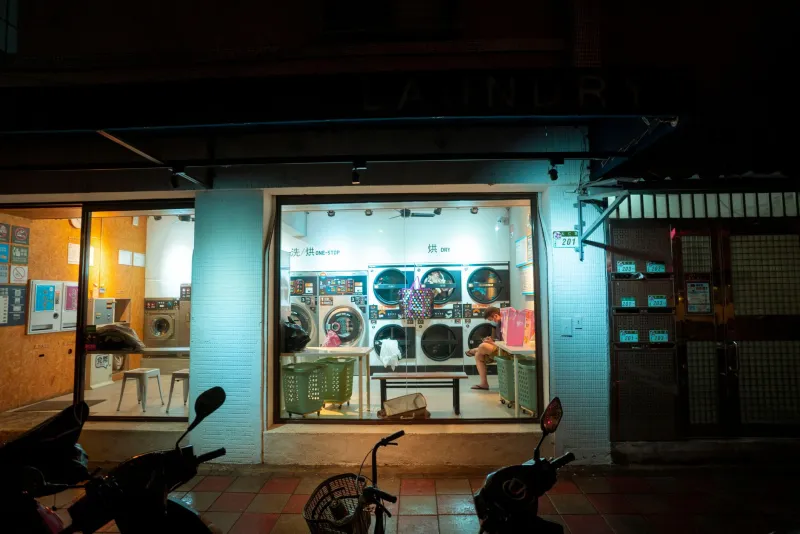
Some rooms ask nothing of you. They do not need you to be clever, cheerful or productive. They simply offer a warm hum, a plastic chair and the steady turning of a drum. For anyone whose home feels too noisy, too shared or too cluttered to settle in, the local launderette can be a quietly useful place to land.
This is not a grand wellness plan. It is a small, practical ritual for the kind of day when your head is full and your living room is fuller. The launderette on the high street — or the one tucked behind the parade of shops — has its own rhythm. People come and go with bags and baskets. Machines slosh and spin. A noticeboard curls at the corners. Nobody expects you to make conversation, and nobody minds if you simply sit.
Why a launderette, of all places?
Most wellbeing advice assumes you have a quiet corner at home. A spare room, perhaps. A candle that smells of cedarwood. A cushion by a window. But plenty of us live in flats with thin walls, houses full of family life, or shared spaces where silence is a rare visitor. The launderette offers something different: a neutral room with a built-in purpose. You are there because the washing needs doing, not because you are trying to fix yourself. That can make it easier to relax.
There is also something grounding about watching a process you cannot hurry. A washing machine does not care about your to-do list. It has its cycles, its pauses, its final spin. You can sit with that. You can let the ordinary machinery of life do its work while you do very little. In a culture that treats waiting as a problem to be solved, that is a small act of quiet rebellion.
Arrive without scrolling
The first step is the simplest and, for many of us, the hardest. When you arrive, resist the urge to reach for your phone. Leave it in your bag. If you have brought a book, fine. If you have brought nothing, even better. Give yourself a minute to notice the room as it is: the smell of clean cotton and warm metal, the low chatter near the change machine, the soft thump of trainers in a dryer.
You do not need to meditate. You do not need to close your eyes and breathe in a particular pattern. Just let your attention rest on what is actually happening. The machine fills. The water begins to move. A red light blinks. Someone folds a towel with great care. This is not a distraction from your day; it is a different part of it. Arriving without scrolling is a way of saying, quietly, that this hour belongs to you too.
Watch one full wash cycle
Once your washing is in, choose a machine and watch one complete cycle. Not the whole wash — just one cycle, from start to finish. It might be the wash, the rinse or the spin. The point is not to become an expert in laundry mechanics. The point is to practise patience with something that will not be rushed.
You will probably notice the urge to check your phone, tidy your bag or start planning dinner. That is normal. Let the urge be there, and let the drum keep turning. The cycle has its own beginning, middle and end. You are simply keeping it company. If your mind wanders, bring it back to the sound. If you feel restless, let your shoulders drop. If you feel sad, let that be there too. The launderette is a forgiving sort of place.
This is also a gentle way to notice the small rhythms of ordinary life. The machine pauses. The water drains. The drum slows, then speeds up again. Nothing dramatic happens, and that is the comfort. Not every difficult day needs a breakthrough. Sometimes it just needs a warm room and a turning drum.
Fold slowly
When the wash is done, take your clothes to the folding table and fold them slowly. Not with the frantic efficiency of a weekend chore, but with the unhurried attention of someone who has nowhere else to be for ten minutes. Match the corners. Smooth the creases. Stack the towels. Let your hands do the work while your mind takes a breather.
Folding slowly is a small lesson in care. It says that the ordinary things — a clean shirt, a dry towel, a pair of socks — are worth handling properly. It also gives you a natural ending to the ritual. You arrived with a bag of chaos; you leave with something ordered. Not because you have solved your life, but because you have looked after one corner of it.
A small note on leaving
On your way out, you might notice the street again: the bus stop, the bakery, the person wrestling a umbrella into shape. The day will still be the day. Your inbox will still be there. But something in you may have loosened, just slightly. That is enough.
The launderette is not a sanctuary in the formal sense. It is not a church or a retreat centre. It is a warm room with a turning drum and a plastic chair. But for an overwhelmed afternoon, that can be a very good place to begin.