A Slow Lap of the Charity Shop: Ten Minutes Without a Basket
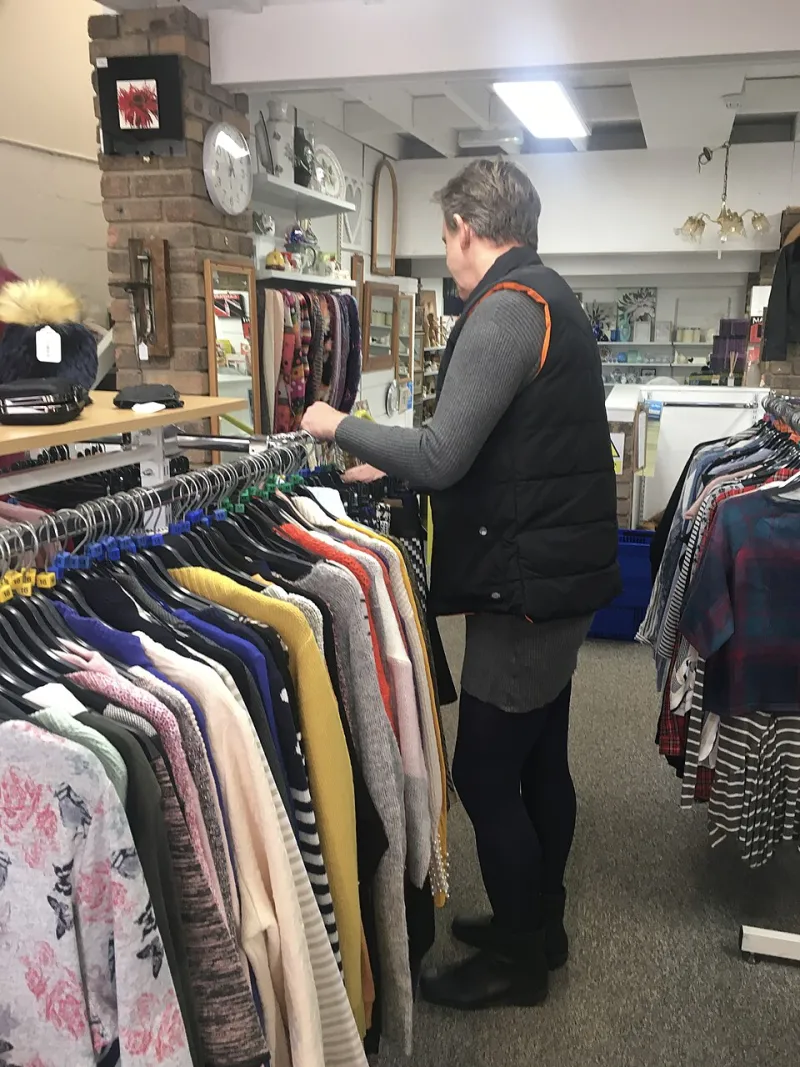
Photo: Buckingham8, CC0, via Wikimedia Commons
There is a particular kind of November rain that makes the high street feel like a corridor of obligations. You are not going anywhere in particular. The bus is late, or the meeting has finished early, or you simply need ten minutes before going home. And there, between the phone shop and the bakery, is the local hospice charity shop with its rails of clothes and its window display of slightly puzzled teddy bears.
You go in. Not to buy anything. Just to look.
That is the whole idea. A charity shop is one of the last unpressured rooms on the high street. Nobody is going to ask if you need help with the fitting room. The music is usually a radio station from somewhere else. The air smells faintly of washing powder and old paperbacks. And everything inside has already been let go of once. That makes it a surprisingly good place to practise a quieter kind of attention.
Why a charity shop suits this sort of thing
Most shops are designed to move you along. They want you to want. The lighting is bright, the shelves are staged, the offers end on Sunday. A charity shop is different. It is not curated in the same way. It is a jumble of other people's decisions. A dinner service that once mattered. A puzzle with a missing piece. A paperback with a name written inside in blue biro.
That jumble can feel chaotic, but it can also feel honest. It is a room full of ordinary life after the fact. And because the objects are already second-hand, they carry a little distance with them. You can admire a thing without needing to own it. You can notice it and then put it back. For anyone whose brain is tired of wanting things, that is a small relief.
Step one: decide before you go in
Before you push the door, make a quiet decision: this is a looking visit, not a shopping visit. You do not need to announce it. You do not need to feel virtuous about it. Just know it.
Leave the basket by the door. Keep your hands free. If you are the sort of person who automatically picks things up, give yourself a simple rule for the next ten minutes: nothing comes home unless it is genuinely needed, and today nothing is needed. That includes the 50p paperback, the framed print of a Highland cow, and the little glass dish that would be perfect for keys if you had a hall table.
The point is not to deny yourself. The point is to see what happens to your attention when the transaction is removed. Most of us are so used to browsing as a prelude to buying that we barely notice the difference. Take the buying away and the looking becomes slower, stranger, more interesting.
Step two: choose one ordinary object
Now walk a slow lap. Not the whole shop — just one section. The bric-a-brac shelf is good. So is the kitchenware, or the children's books, or the rack of scarves near the till.
Choose one object that you would normally walk past. Not the best thing. Not the funniest thing. Something plain. A side plate with a gold rim worn thin. A corkscrew with a wooden handle. A small pottery jug. A walking stick with a leather strap that has been held smooth by somebody's hand.
Pick it up, if the shop allows it. Turn it over. Notice the weight. Look at the chip on the rim, the scratch on the base, the faded pattern. Ask yourself a gentle question: what room might this have lived in? What table? What shelf? You are not trying to invent a whole novel. You are just letting one ordinary object be real for a minute.
This is the heart of the practice. Most of us look at things in order to decide about them — yes, no, maybe, how much, where would it go. For ten minutes, you are looking at something simply to notice it. That is a different gear. It is closer to the way you might look at a tree or a cloud. The object does not need anything from you. Neither do you.
Step three: leave with a sentence, not a purchase
Before you leave, make one observation. A single sentence is enough. Something like: 'The green jug had a chip shaped like a comma.' Or: 'Someone had written their name in the front of a 1970s cookbook and then crossed it out.' Or: 'There was a row of mugs, all different, all waiting.'
You can say it to yourself. You can type it into your phone. You can hold it in your head on the walk to the bus stop. The sentence is the souvenir. It is proof that you paid attention. And because it is not an object, it does not need dusting, storing, or eventually donating to the same shop.
If you do find yourself wanting something, that is fine too. Notice the wanting. Let it be there. You do not have to act on it. You can admire the feeling of 'oh, that's lovely' and then let the lovely thing stay on the shelf. The shop will keep it for someone else. That is part of the calm.
The quiet after
A charity shop is a small lesson in impermanence. Everything on those rails was once wanted and then released. The tea set, the jigsaw, the coat that was someone's best. None of it is sad, exactly. It is just ordinary. Things move on. People move on. The shop holds the middle part of that story.
Ten minutes of browsing without buying will not change your life. It is not meant to. But it can change the shape of an afternoon. It can make the high street feel less like a corridor of demands and more like a place where you are allowed to simply look. And on a wet Tuesday in November, that is no small thing.
Next time you have a spare ten minutes, try it. Choose the charity shop with the slightly wobbly sign and the window display that makes no sense. Go in with empty hands. Take one slow lap. Notice one ordinary thing. Leave with a sentence instead of a bag. The practice costs nothing, which is rather the point.