Upstairs, Outward: A Bus Window Practice for Busy Days
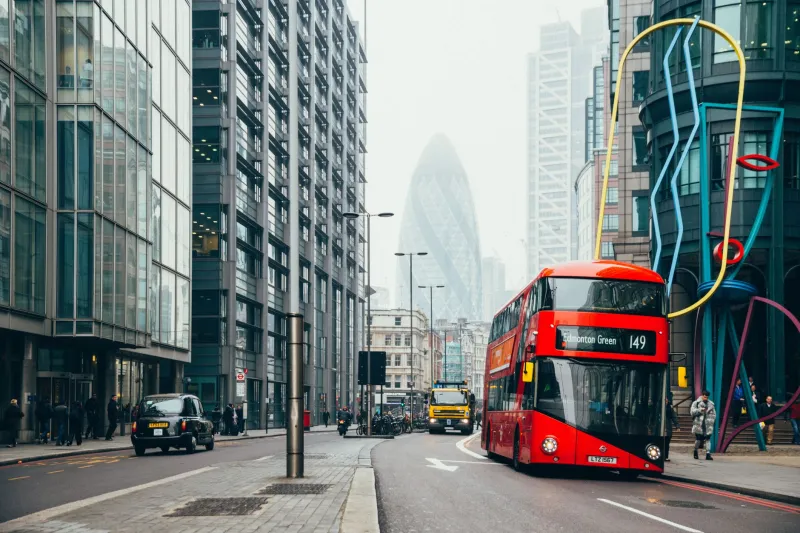
Most of us treat the bus as a gap between places — a stretch of time to endure, a phone to scroll through, a countdown of stops. But a bus is also a room that moves. It has a rhythm, a view, and a beginning and an end. If you take a short ride on the top deck, with no particular purpose beyond the ride itself, you can find a small pocket of quiet that doesn't ask you to buy anything, book anything or become a different person.
This is not about turning public transport into a performance of wellness. It's about borrowing the ordinary. The bus is already going somewhere; you just have to let yourself go with it.
Why the top deck changes the pace
There is a reason people gravitate upstairs. The view is wider, the noise is softer, and you are further from the doors and the shuffle of passengers. You can see over hedges and garden walls. You can watch the tops of buildings, the weather moving across the sky, the way a town looks when you are not at street level. In London, the top front of a route that crosses the river is its own small cinema. Outside the capital, a loop around a market town or a ride past a retail park can do just as well.
The movement helps, too. A bus is not a train; it stops and starts, leans into corners, waits at lights. That rhythm gives your eyes and body something to follow without demanding your full attention. It is enough to occupy the restless part of the mind, which is often the part that makes stillness feel impossible.
Choose a route that asks little of you
The first step is to pick a ride that is short and low-stakes. Ten to twenty minutes is plenty. You are not trying to get anywhere. In fact, the best route may be one that ends somewhere you don't need to be: a nearby village, a park-and-ride, the next town along. Check your local operator's app or the timetable at the stop. If you have a bus pass, use it for a loop. If not, a single or a day ticket is enough.
Try to avoid the school rush and the peak commute if you can. Mid-morning or early afternoon often has a gentler atmosphere. Choose a stop with a bench, a café or a shop nearby, so getting off doesn't feel like being dropped in the middle of nowhere.
Settle in before the doors close
Once you're upstairs, sit down properly. Put your bag on the floor or on your lap, not on the seat beside you if the bus is filling up. Feel the seat beneath you. Let your feet rest flat. Take three slow breaths — not big, dramatic ones, just enough to notice that you have arrived in your own body.
Then let the bus pull away before you decide anything. You don't need to close your eyes or look serene. You can simply look out of the window. If you want, put your phone in your pocket or turn it face down. This isn't a rule; it's an invitation.
A practice in three small moves
Here is a simple structure you can use, loosely inspired by the idea of three small anchors.
First, arrive. Notice three points of contact: your back against the seat, your feet on the floor, your hands resting somewhere. Let the sound of the engine and the passengers be there without trying to fix it.
Second, watch. Choose one thing to follow out of the window. It might be trees, brickwork, front gardens, shop signs, or the way the light falls on a wall. When your mind wanders — and it will — bring it back to that one thing. This is not a concentration test. It is a gentle return.
Third, release. Use the stops as small bells. Each time the bus slows and the doors open, let one thought go. You don't have to solve it. You can imagine leaving it at the stop, like a passenger getting off. Then carry on.
What to do when the bus is busy
Some days the top deck will be full. There will be a conversation you can't help overhearing, a buggy in the aisle, a teenager playing music through a speaker. You don't have to force calm. You can do the same practice on the lower deck, or simply wait for the next bus. You can also take the practice off the bus altogether and sit on a bench at the interchange for five minutes.
The point is not to have a perfect experience. The point is to give yourself a different kind of pause. A pause with a view.
Getting off is part of it
When your stop comes, don't grade the ride. A journey where you spent nine minutes thinking about emails is not a failed meditation. It was a bus ride. You still gave your eyes a rest from the screen and your body a rest from walking. Step down carefully, thank the driver if that's your habit, and walk the last few minutes slowly if you can.
You might notice that the day feels slightly less compressed. Not transformed — just a little more spacious. That is enough. You can take the same route again next week, or find a different one. The bus will be there, going about its ordinary business, ready to lend you a moving room for a little while.
This is a small wellbeing practice, not a treatment for anxiety or depression. If you are struggling, please speak to your GP or a trusted professional.